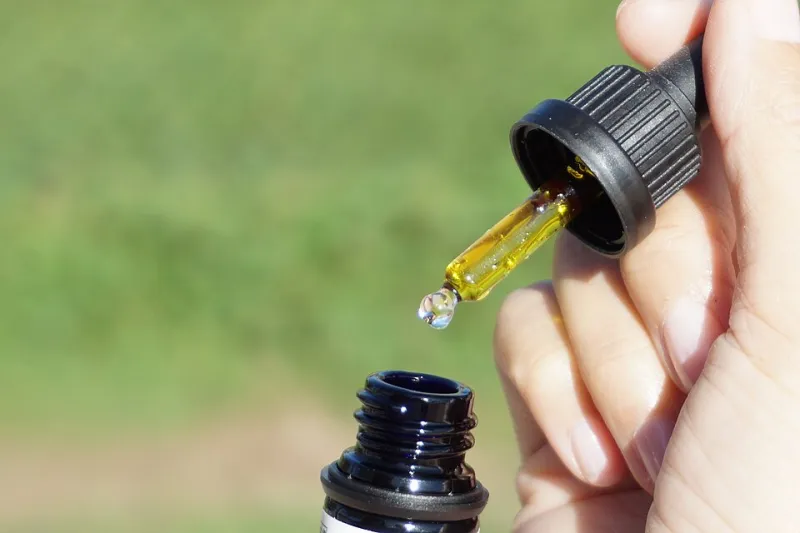
The Dropper and the Driveway: How to Think About CBD Before You Take the Wheel
Photo: Trollercoaster42, CC BY-SA 4.0, via Wikimedia Commons
There's a question that lands in our inbox more often than almost any other, usually late on a Sunday evening: I've had a couple of drops — am I alright to drive? It's a fair question, and it deserves better than a shrug. What follows is our attempt at a genuinely useful answer: no alarmism, no false comfort, just the things worth knowing before you reach for the keys.
Legal to buy and safe to drive are two separate questions
CBD is not a controlled drug in the UK. You can buy it on the high street, in a farm shop, and from roughly nine thousand websites. None of that tells you anything at all about whether you should be behind the wheel half an hour later.
The reason is simple: what you're buying isn't one standardised substance. A bottle labelled "CBD oil" might contain CBD isolate in MCT oil, a broad-spectrum extract, or a full-spectrum one with a small amount of THC still present. It might contain what the label says. It might not.
Regulation has tightened — the Food Standards Agency's novel food register now holds a proper list of products permitted to stay on sale — but a place on that register is a paperwork milestone, not a guarantee of consistency from batch to batch. If you want to know what's in your bottle, you have to look.
What the law in the UK actually says
Two sections of the Road Traffic Act 1988 do most of the work here.
Section 4 covers driving while unfit through drink or drugs. That includes medicines, and it includes anything else you've taken. If your driving is impaired and the impairment traces back to a substance, that's an offence — regardless of whether the substance was legal, prescribed, or bought in a nice glass bottle with a hemp leaf on it.
Section 5A sets specified limits for certain controlled drugs, THC among them. The limit for THC is 2 micrograms per litre of blood. It's a low threshold, drawn up with regular cannabis users in mind rather than occasional CBD drinkers, but it exists — and trace THC in a full-spectrum product is not nothing.
Worth remembering too: police can require a preliminary test, usually a roadside wipe, and refusing without a reasonable excuse is itself an offence.
Read the label like you actually mean it
Most CBD labels are better at atmosphere than information. Here's what to hunt for:
- A batch number and a certificate of analysis. If the shop or the website can't show you one for the batch you're holding, you don't really know what you've got.
- THC content, stated numerically. "THC-free" is a marketing phrase. "THC not detected" or "THC <0.01%" is a measurement. They are not the same claim.
- Milligrams per millilitre, not just per bottle. A 10ml bottle with 1000mg sounds potent until you work out it's 100mg per ml — which is a great deal per drop.
- Full-spectrum, broad-spectrum or isolate. Full-spectrum carries the widest range of trace cannabinoids, THC included.
- Whether the product appears on the FSA's novel food list. Not a safety guarantee, but a sensible starting point.
If you take any prescription medication — antidepressants, blood thinners, epilepsy medication, anything carrying a grapefruit warning — have a word with your pharmacist before adding CBD to the picture. That isn't us being cautious for the sake of it; it's a genuine interaction question a professional can settle in five minutes.
Nobody can give you a reliable number of hours
This is the part people find most frustrating. There's no pint-and-an-hour rule, because clearance depends on body weight, metabolism, how often you use it, what you've eaten and the format you chose. Someone on a high-strength oil daily for months has a very different picture from someone trying two drops for the first time.
What we can say, sensibly:
- Don't dose and dash. If you're driving in the next hour, that's not the moment to try a new product or a bigger serving.
- Experiment on a non-driving day. A quiet Saturday at home tells you far more than a Tuesday morning commute.
- Keep a small note. Dose, time, how you felt. Ten seconds of admin turns guesswork into something you can learn from.
- Treat "I feel completely normal" with mild suspicion. CBD is subtle by design. Subtle doesn't mean absent.
The things that stack up
CBD rarely travels alone. A couple of drops, a glass of wine, an antihistamine for the November cold, four hours of sleep and a two-hour run up the M6 — that's not a CBD question, it's a compounding one. Fatigue alone is a bigger impairment risk on British roads than most of us credit.
So be honest about the whole picture, not just the bottle.
If you're stopped
Be straightforward. Say what you've taken and when, and keep the product in the car if you have it — a labelled bottle with a batch number is more use than a vague memory. A roadside cannabis wipe can pick up THC, and a positive screen usually leads to a blood test at the station, which is where the legal limit actually gets measured.
Arguing the toss or claiming you've taken nothing helps nobody, least of all you.
Work, insurance and the grey areas
If you drive for a living, or your employer runs a drug and alcohol policy, read it properly. Plenty of UK workplaces operate zero-tolerance testing that makes no distinction between a prescribed medicine, a weekend joint and a full-spectrum CBD oil. You're entitled to ask how the policy applies to you before it becomes a conversation you didn't plan for.
And on insurance: policies generally assume you're fit to drive. Impairment is impairment, whatever caused it.
A short, sensible routine
Try a new product on a day you're not going anywhere. Keep the bottle out of the glovebox. Note the batch. Check in with a pharmacist if you take anything else. And if you feel even slightly off — foggy, heavy, slower than usual — hand over the keys. No article, including this one, makes that call for you.
Liberation, as we see it, has always been about having more choices rather than fewer. Letting a friend drive, getting the bus, or simply leaving the car at home is one of those choices. It isn't a sacrifice. It's good sense.
This piece is general information, not legal or medical advice. If you're unsure about your own situation, speak to your GP, your pharmacist, or a solicitor.