The Half-Drop Experiment: What Happens When You Try Less CBD Instead of More
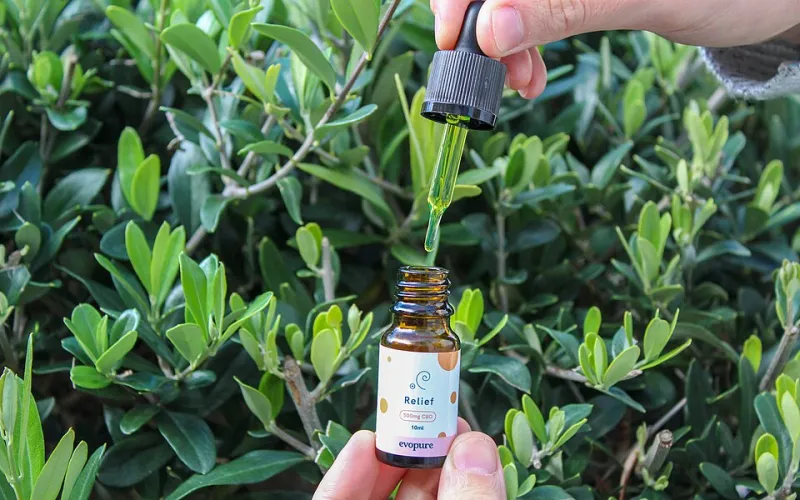
Photo: Evopure, CC BY-SA 2.0, via Wikimedia Commons
There is a pattern with CBD that almost nobody plans and almost everybody recognises. You start with a couple of drops. A week later you wonder if three would be better. By the second bottle you are taking it twice a day and are not entirely sure what it is doing any more — only that stopping feels like a risk.
More feels like effort. More feels like taking it seriously. But more is also the easiest way to lose track of what you are actually noticing.
So consider the opposite move: a deliberate, temporary reduction. Not as a cleanse, not as a challenge, and definitely not as a claim that less is secretly better. Just as a small experiment you run on yourself, with a notebook, for a fortnight.
Where the escalation habit comes from
CBD labels encourage a certain maths. The bottle says 1,000mg; the dropper says 0.5ml; the internet says everyone has a different sweet spot. So you inch upward, dose by dose, because upward is the only direction with instructions attached.
The trouble is that once you are at a higher dose, you have no comparison. You cannot feel the difference between the current amount and a smaller one, because you have not been smaller for months. Your baseline has quietly moved, and with it, your ability to tell what any of it is doing.
What less is more actually means
Let us be careful here. You will see the phrase everywhere, usually attached to a confident explanation involving receptors and curves. The honest version is much more modest: people respond to CBD differently, some report that a smaller amount suits them better, and the evidence for any tidy dose-response rule is thin and mixed.
That does not make the idea wrong. It makes it unproven — which is exactly why it is worth testing rather than repeating. Treat it as a hypothesis, not a law. You are not looking for proof that less is better. You are looking for evidence about you.
Set the experiment up properly
A few rules make the whole thing cleaner:
- Pick a starting point you can halve. If you take four drops twice a day, aim for two. If you are on one drop, aim for a half-drop dose on alternate days — awkward, but doable with a steady hand.
- Change one thing. Same product, same time of day, same everything else. Do not quit caffeine and start running in the same fortnight, or you will learn nothing.
- Give it two weeks. CBD clears from the body over roughly a day or two, so the first few days of any change are noisy. A fortnight gives you enough of a run to see a pattern.
- Then go back. The last three or four days, return to your original dose. This is the part most people skip, and it is the part that tells you the most.
The noticing journal
One page, two weeks, four lines a day. Same time each evening, before bed, no more than ninety seconds.
Rate each of these from one to five:
- Getting to sleep — how long it took, roughly
- The 4pm dip — how sharp it felt
- Body tension — jaw, shoulders, the usual suspects
- Mood on waking — not the whole day, just the first ten minutes
Then one line of plain description. Something like: slept fine but woke at 3am, or long day, no real difference, or surprisingly steady despite a rubbish meeting.
Keep the sheet somewhere boring and visible — the inside of a kitchen cupboard door works well. Anything more elaborate will not survive past Thursday.
Reading your own notes without fooling yourself
When the fortnight is up, resist the urge to declare a winner immediately. A few things to hold in mind:
November is doing things to you. Shorter days, darker afternoons and a run of colds will move your sleep and mood whether or not a dropper is involved. Note the weather. Note the week.
Expectation is a real effect. If you believe the reduction will be revealing, it may well feel revealing. That does not make your notes worthless, but it does mean a change of two points across the board deserves more scepticism than a change of one.
Look at the direction, not the number. Three days of slightly better sleep inside a fortnight of otherwise identical scores is not a finding. A consistent shift in the same direction across both weeks is more interesting.
Check the return leg. If you felt better on the lower dose and then felt the same when you went back up, that is genuinely worth knowing. If things slid back down, you have learned something different and equally useful.
The label maths, quickly
You cannot halve a dose you cannot measure. Most oils state strength as milligrams of CBD in the bottle. Divide that by the volume in millilitres to get milligrams per millilitre, then divide by roughly twenty for milligrams per drop.
So a 1,000mg bottle in 10ml is 100mg per ml, and about 5mg per drop. Halving four drops means two drops, or roughly 10mg instead of 20mg. Write your own numbers on the journal page before you start, so you are not doing arithmetic while tired.
One caution: not every dropper is calibrated the same way, and some products state strength per dose rather than per bottle. If the label is genuinely unclear, ask the retailer in writing. A vague answer is informative in itself.
When to stop the experiment
Curiosity has limits, and they are worth stating plainly. Abandon the fortnight and go back to what you were doing, or speak to a clinician, if:
- your sleep or mood gets noticeably worse rather than just different
- you develop new symptoms that concern you
- you find yourself anxious about the reduction itself
- you take prescription medicines that interact with how the liver processes things
- you are pregnant, breastfeeding, under 18, or due surgery
- you are using CBD for something a GP should be looking at
This is not a test to pass. It is information gathering, and you are allowed to stop collecting at any point.
What to do with the results
Most people end the fortnight with one of three outcomes. The lower dose felt the same, in which case you have found a cheaper, simpler routine and can bank it. The lower dose felt worse, in which case you now know your current amount is doing something — a genuinely reassuring discovery. Or the picture is muddy, which is the most common result of all, and a perfectly good reason to run it again in spring when the light is on your side.
What you will almost certainly have, whatever the numbers say, is a clearer sense of what you are taking and why. That is worth more than another bottle.
General information only, not medical advice. If you are unsure about your dose or your health, speak to your GP or pharmacist.